For the third assignment, I chose to look at the Trans-Atlantic Slave Data to see if I could play around with the visualizations, hoping that I would find connections that I would be able to write about.
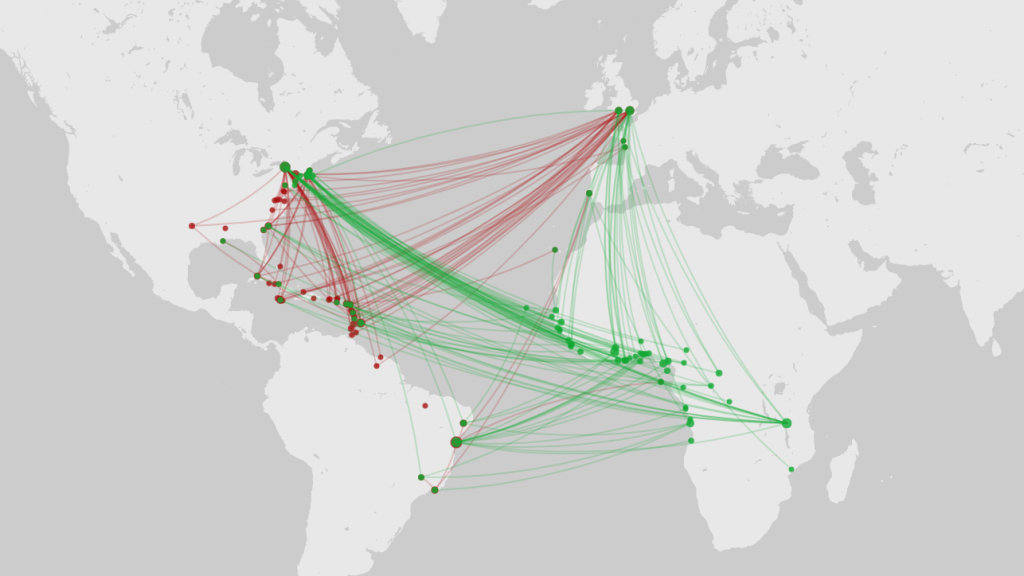
For my first visualization, I wanted to see connections of the places that the enslaved people were sent. This involved setting two visual layers on the map, one layer representing where slaves were bought and where their journeys began, and the other representing where their journeys began to where they disembarked. To achieve this, I had to select three variables – the places that the enslaved people were bought, where they had embarked on their journey and where they had disembarked. There was still a lot of data to interpret for the set of all voyages taken, so I narrowed it down more to the voyages of the top three named ships. The resulting visualization was interesting, and I interpreted it to infer that a lot of slaves whose final destination was South America were transported to the East Coast before going to South America, as opposed to having a direct voyage there.
I also wanted to look for links between the three ships that I had filtered for the data. This time, I wanted to see how many ports they had in common with each other and see if there was any correlation between them. I pulled up the ships and the ports that they were associated with on the graph to see if there were multiple common ports between them. To further polarize the view, I set the names of the ships to anchor in a triangular fashion, as shown below. We can see that while Nancy and Mary had the most number of ports in common, there was much less correlation between them and the NS da ConceiCao Antonio e Almas.
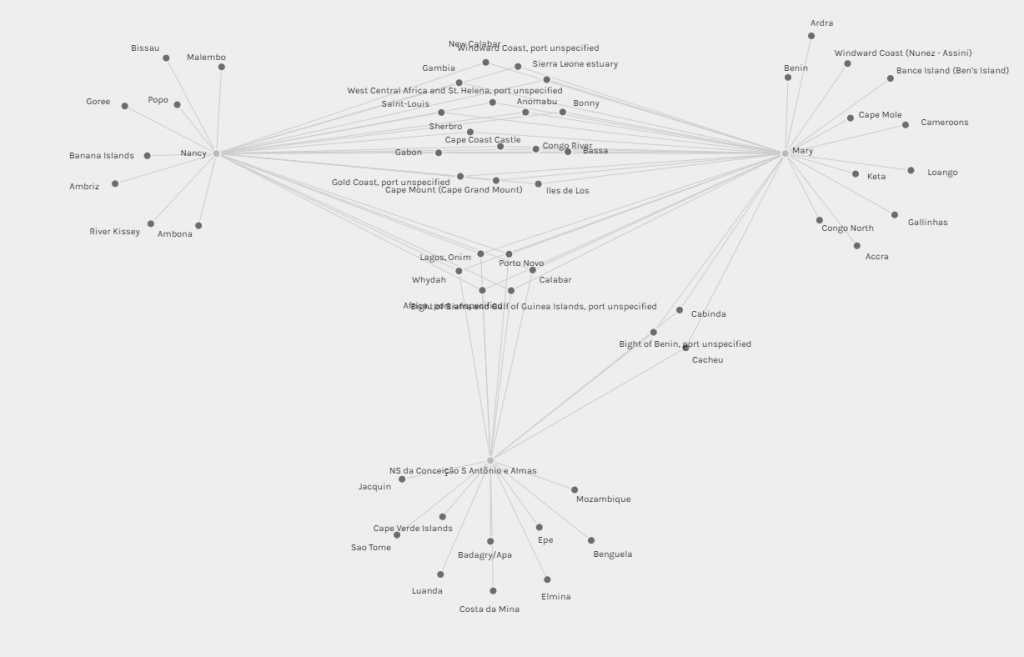
The results, in the context of the service period and origins of the ships, make sense, as Mary and Nancy were affiliated with the United Kingdom and were launched within twenty years of each other, Nancy having been launched in 1789 and Mary in 1806. The NS da ConceiCao Antonio e Almas was launched much earlier, with records indicating that it was in service from 1691 to 1782 (ShipIndex). Another possible explanation is that the countries that owned the ships respected each other’s trade routes and did not infringe on each other’s paths. The timeline JS view below shows how much overlap there was between the three ships and how they may have influenced each other.
These results that I have shown here display data that has been filtered and represented in a different way than it was given to me, which was on an excel sheet. By selectively using parts of this data and making a visualization out of it, I am effectively skewing the dataset to my own ends and drawing new conclusions on data that I already have. By using timelines, I added more meaning to the years that the ships were active, graphically improving their meaning to suit my narrative. I think that this makes me what Johanna Drucker describes a ‘knowledge generator.’
