In working with the Cushman Collection data, I was curious about the relationship between an individual’s gender and their position in the workforce. I theorized that – especially during the earlier years of the dataset – men would hold positions that were considered more prestigious when compared to positions held by women.
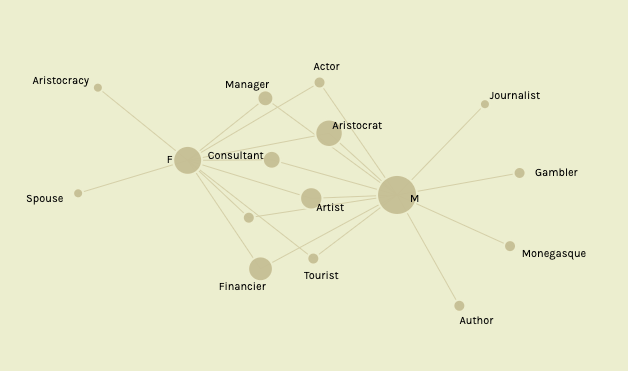
In using Palladio, I first wanted to look at all of the data; in this context, all of the positions held by both men and women for the provided dates. In this sense, this data is representational because the data must be understood within the context of its time. The arrangement of this visualization is important because it shows not only what positions are exclusive to men or women, but also which positions overlap in the two groups. Women’s positions that are exclusively for women are positions that embrace hegemonic femininity, or the traditional view of a woman’s place in society. The positions that are exclusively made up of women are ‘spouse’ and ‘aristocracy,’ positions that derive worth from some sort of outside source, whether it be a woman’s husband or a woman’s wealthy family. In contrast, the positions that are exclusively made up of men include positions such as author and journalist, positions that are often well-respected and viewed as legitimate. Positions that were shared between men and women range in how they are viewed by society, with the high-level shared positions being consultants, managers, and financiers. In first looking at the data, my hypothesis was that these higher-level positions would not be held by women until after the 20th century.
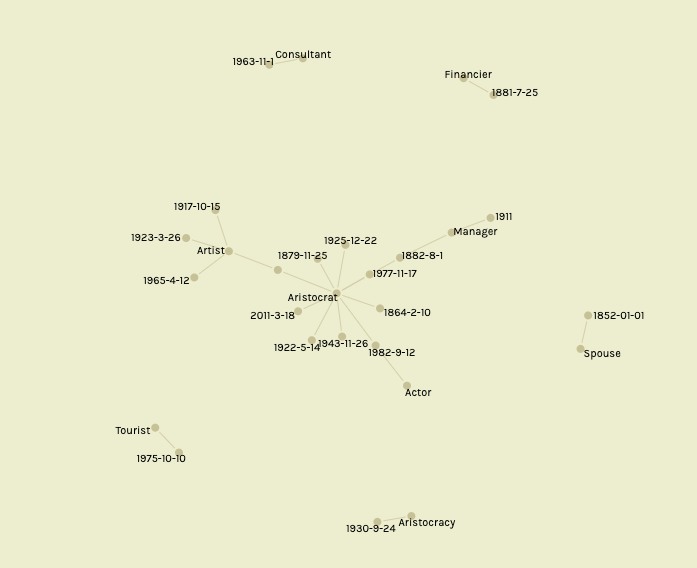
Female Positions & Death Dates 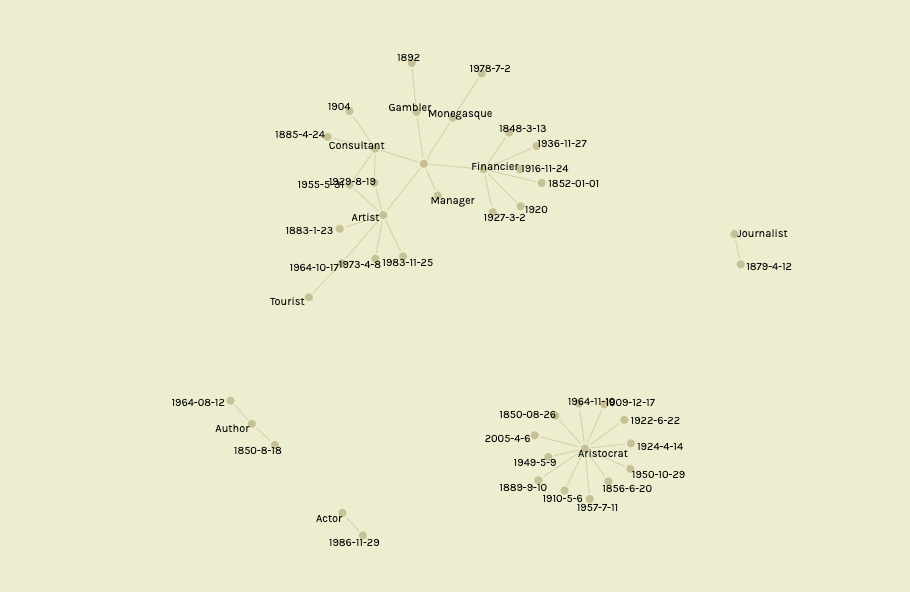
Male Positions & Death Dates 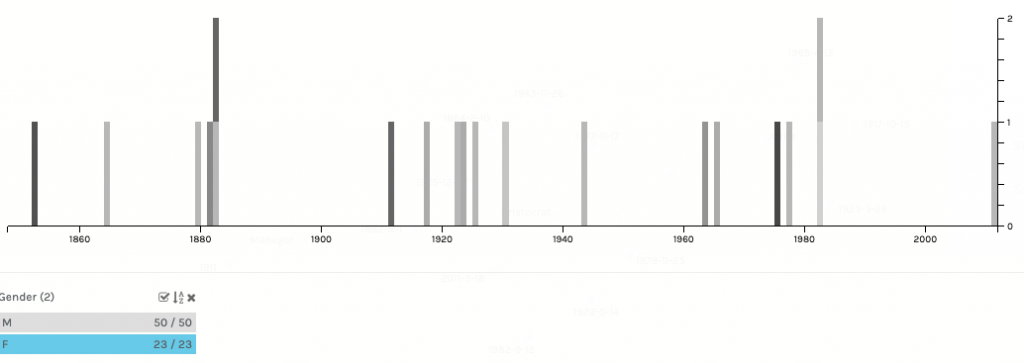
In trying to create a timeline in Palladio, I found the software to be ineffective because it would not mention position titles without hovering over the bars, nor would it mention the counts for each position.
After getting an overview of positions held by both men and women in this dataset, I wanted to explore how these positions would be impacted with the passing of time. I did this by filtering the data by gender, then by date of the individual’s death (thus determining the time period in which they lived). Many of women’s positions shown on Palladio were post-1920s, whereas men’s positions were fairly evenly distributed throughout the available dates. In an effort to explore these relationships further, I moved onto Timeline JS to determine what was happening in the United States around this date range. I chose only a few key events and turning points to include in the timeline, because there are truly so many important events that have occurred surrounding the topic of women’s rights.
This information is valuable because, as Drucker notes, “almost all information visualizations are reifications of mis-information.” Being able to analyze the data for women’s positions in the United States both literally with regards to their careers as well as socially with regards to legislation allows viewers to gain context and understanding for the different positions that women have held over the years.
