I had a completely different experience using and learning Gephi for this assignment than when learning other platforms. I found the platform harder to navigate than others as it is not as “user friendly.” I had to work with my data a lot more when using Gephi which forced me to prepare my information before plugging it into the platform. There was a lot of new technology I had to learn in order to use Gephi in which I am still not comfortable with. I was also tasked with the duty to understand how data operates on a higher level. With other programs we have used in class, we have been able to map differences between data; however, with Gephi, we can only showcase the connections or relationships between similar nodes. Although Gephi is limiting in some ways, and may be more time consuming, it also has many benefits exclusive to the platform. Gephi allows users to measure relationships by the metrics between them. Gephi also gives users the ability to visualize networks and understand how the information interacts with each other (between one another). Graphing networks of human interaction can help societies understand and analyze how people interact with one another. As a result, readers may better understand their relationships with individuals. Gephi allows users to filter their data into different kinds of metrics in order to provide a better understanding of the data being used to create the network.
I struggled with creating a question for what I wanted to visualize on Gephi but as I collected data started naturally asking: “I know why my friends are friends with me, but how do they know each other?” My goal in this project was to illustrate the relationships shared between my friends at Bucknell. I created connections between everyone and showed relationships between people based on five major relationships: major, college, sorority, roommates from freshman year, and roommates from this year. There is no modularity in my data set as there was an existing connection between everyone already. Every girl is their own node, and every girl is connected to one another as we all have preexisting friendships. It is important understand that a node is simply an person or single thing and edges refer to the relationships between nodes. Graham shares: “everything about a network pivots on these two building blocks,” (Graham 202) referring to nodes and edges. It is also important to analyze networks carefully as “it is easy to become hypnotized by the complexity of a network, to succumb to the desire of connecting everything and, in so doing, learning nothing” (Graham 201). My network of friends originally appeared like so:
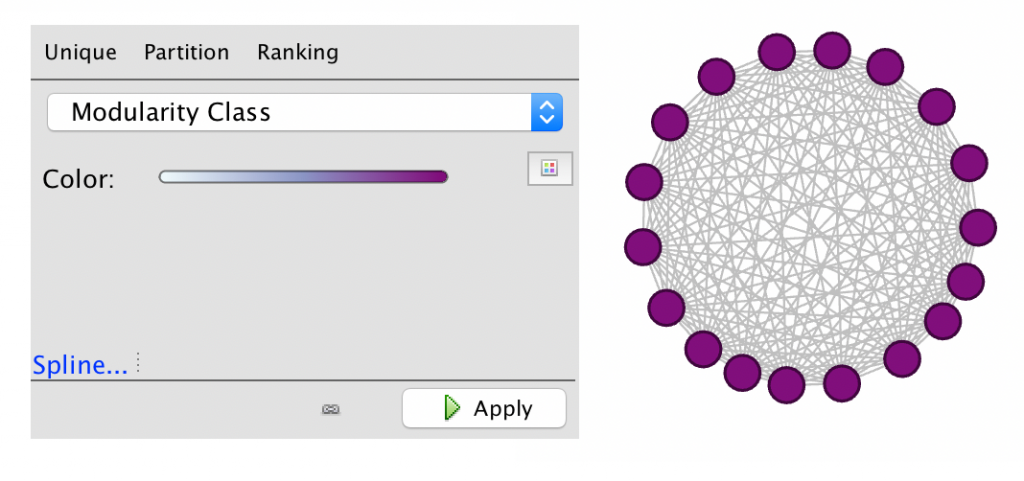
The color of the nodes are all the same as there is no difference in modularity (explained above). Following the advice of Graham, I then filtered my data to showcase what college, girls in my sorority, were in. I wanted to explore my data in many ways so when I limited a lot of the data I inputed I was able to visualize that most of my friends in my sorority are in the college of Arts and Sciences with me. With this data supporting my claim, I would assume the girls who are in my sorority were previously friends due to classes shared in the Arts and Colleges school:
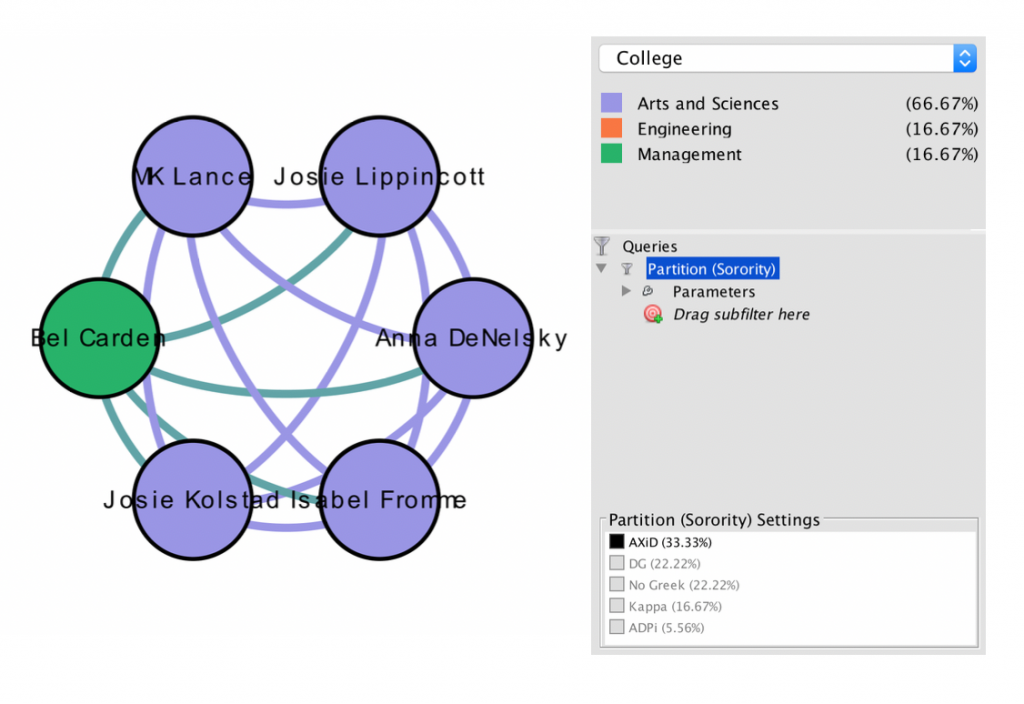
When looking at this visualization the reader can understand that only 33.33% of my friends are in Alpha Xi Delta with me; however, it is easy to see that most of the girls in the college of Arts and Sciences are also in Alpha Xi Delta.
I next visualized the relationships between my friends in the college of Management. Surprisingly enough, all of three of them were Finance majors. I enjoyed visualizing this as I was able to build upon a past project I did in Palladio. I am fascinated by the amount of women pursuing, what used to be, predominately male career fields and found it amusing that my friends were following that career path, as opposed to more female aligned majors in the college (such as MIDE). I could draw a connection between these girls as they are in the same college and the same major:
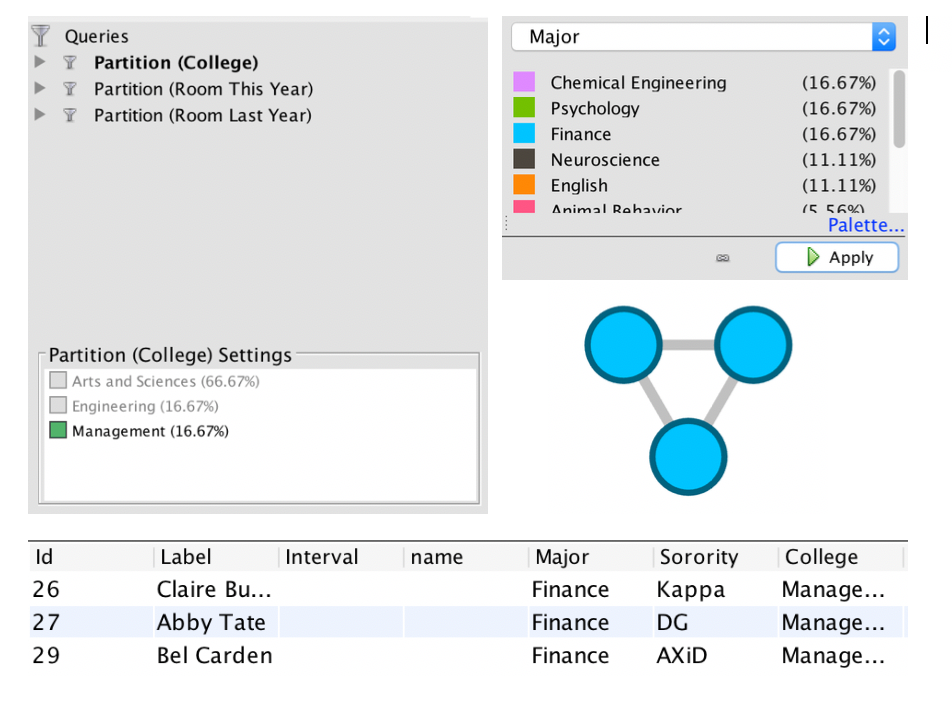
By filtering the data in this way I was able to visualize “intangible structures that are invisible and undetectable to the human eye” (Lima 80). For example, in the visualization above, I was able to draw a relationship between 3 people that existed in 2 different ways. If I told the reader of this connection without filtering my data, and changing my visualization, it would not be easy to understand.
Gephi allowed me to explore the relationships between friends who surround me on Bucknell’s small campus. I learned that the relationship between nodes matters as well as the edges that connect them. There were not arrows on any of the edges as the relationships were equally significant to both nodes, there was no direction of relationship. Lima writes of a “rhizomatic relationship,” a visualization in which the reader does not know beginning or end (Lima 44). The relationships are patterns between people and I chose to visualize them in a circle as it is easy to understand and shows that it is a continuous loop of relationships, the visualization does not stop anywhere. By using Gephi I was able to see patterns and relationships I may not have noticed within my friends.
