Using the Slave Names database, US Slavery in the 1860s and Slave Narratives, I created six visualizations that are meant to display the journey many slaves took to the new world. I did this through looking at words that are associated with traveling and the hopes and also the realities it embodied for these people.
Voyant Visualizations
This wordtree with ship as the root word shows that the words most commonly associated with ship include those such as, merchant, gun, slave, and large. These word associations allow us to draw conclusions what the text was about and what might the person writing it was experiencing.
This bubbleline displays where in the seven texts are the words ship, captain, and freedom are located and the occurrence of them. As seen, a few of the texts barely mention these words, however in Olaudah Equiano’s writing it is shown that there is a chronological connection between talking about a ship, a captain and freedom.
A link visualization, similar to that of the word tree displays a network of words that are of higher frequency and words that are in high proximity to one another. In this case, the words in blue, the root words, are connected to words that are commonly associated which we can look at to determine what freedom meant to the author, or that time was a large aspect of being on a ship and gaining freedom.
Tableau Visualizations
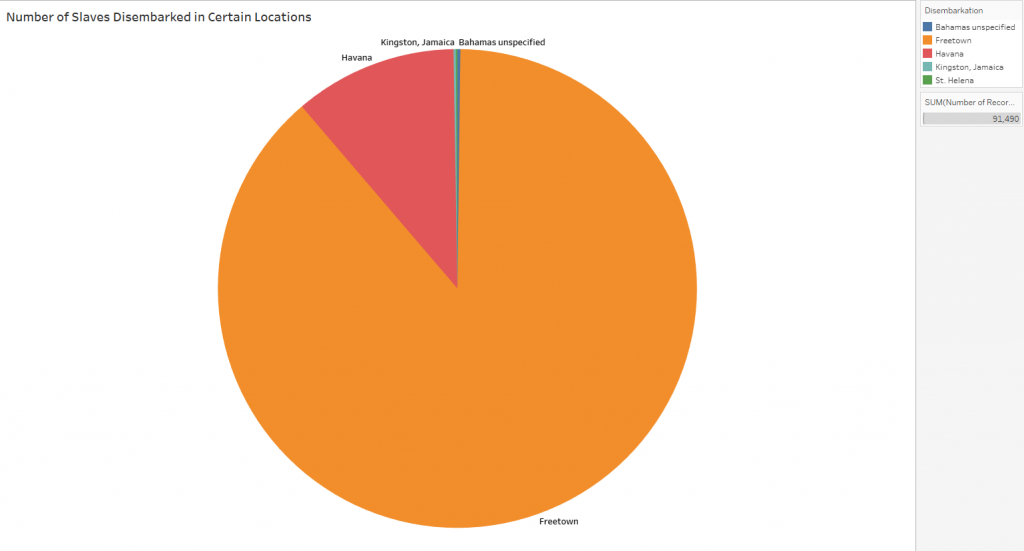
The slaves that were accounted for in the dataset disembarked in one of five places, and this pie chart visually displays the large number of slaves that disembarked in Freetown and Havana. The stark differences in numbers allows readers to draw conclusions that many more slaves must have been present in Freetown, or that there was a mistake or bias in the data.
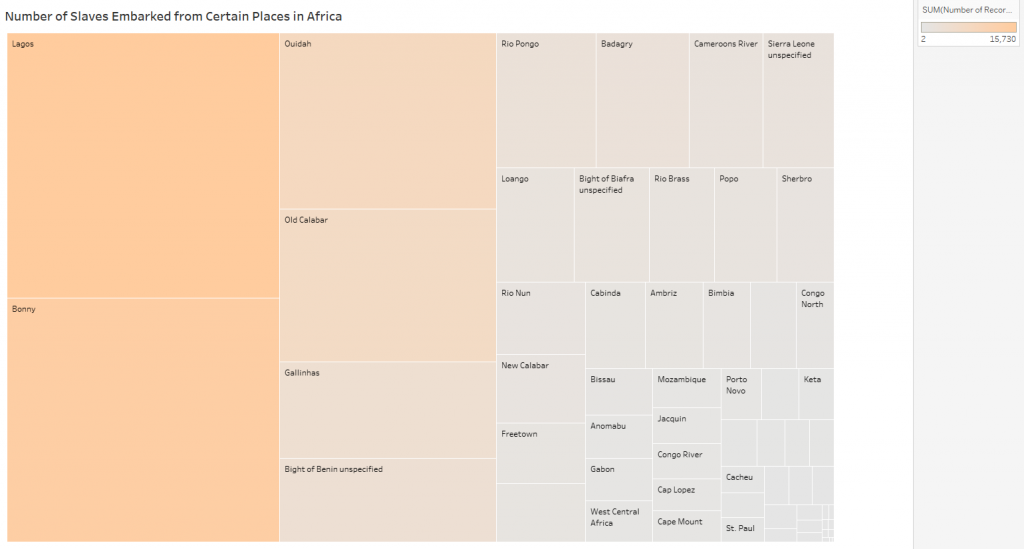
This tree map displays the places that slaves embarked from, and the concentration of slaves from that place. The color and the size of the rectangle display the concentration, showing that some of the areas of Africa were affected more than others.
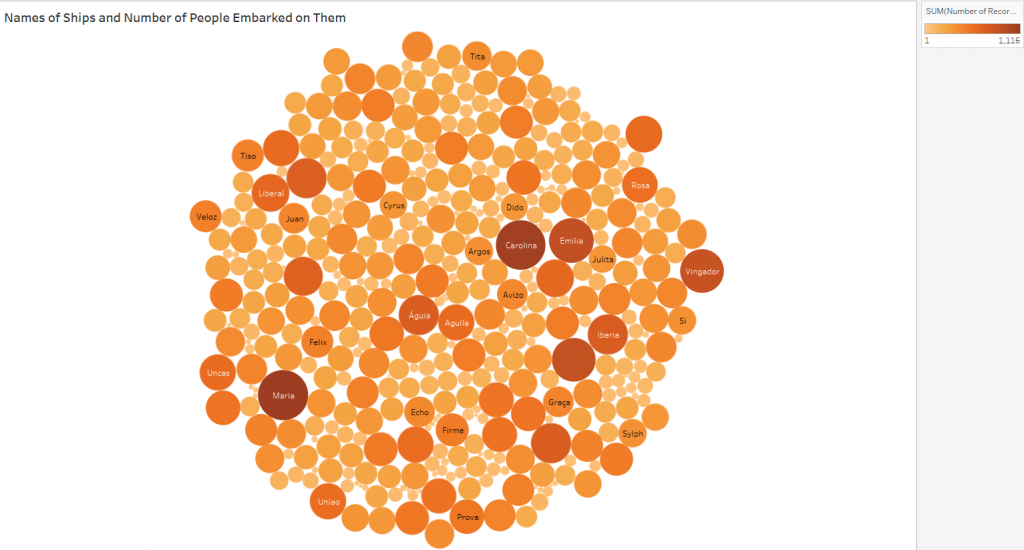
Similar to the tree map, this packed bubble chart shows the concentration of slaves who embarked on certain ships. Seeing the data in this way it is easier to see that many of the slaves who were accounted for were on a few major boats, or that those ships were much larger than others.
Comparison
Voyant is a platform that analyses qualitative data and creates visualizations based on them. Tableau is similar in that it creates visualizations of data to make it easier to view and understand, however it looks specifically at quantitative datasets. Voyant is able to look deeper into the written words of authors and analyze biases and backgrounds and how they might affect the writing and content of texts, where tableau is able to look at numbers and make assumptions based off of looking at relationships of numbers.
Visualization Practices
The creation of interactive visualizations and construction of text corpuses has verified Tanya Clement’s observation that visual platforms allow for greater insight, vantage points, and authenticity of data because they bring new light to datasets that cannot be seen by looking at numbers of texts in a spreadsheet. They can highlight relationships between variables that seemingly are not related prior, but indeed draw interesting conclusions. Defamiliarizing and deconstructing texts is helpful in creating a multidimensional viewpoint, looking at more than just the words on a page, but what they mean and why they are used. Digital visualizations do not simplify the data, it makes it easier to understand and analyze, showing immutable truths.
