How do the Digital Humanities design visualizations of patterns of information and networks? What counts as data in the humanities? And what does the visualization of this data reveal that differs from traditional/analog methods of humanistic enquiry? For example, how do we visualize texts?
The humanities have always produced visualizations of knowledge systems, whether through maps, timelines, charts, real or imagined. And when we visualize digitally we need to follow principles, long-established in design circles, that rest upon concepts of depth, color, and line (Drucker 2014). Manuel Lima, the Portuguese-born designer and thinker, invites
us to revisit Edward Tufte’s principles of design in the digital age through his elegant and scholarly works, in which he, like Drucker, argues for the act of visualization itself bring a producer of knowledge: the phenomenological becomes epistemological (Lima 2011; 2014).
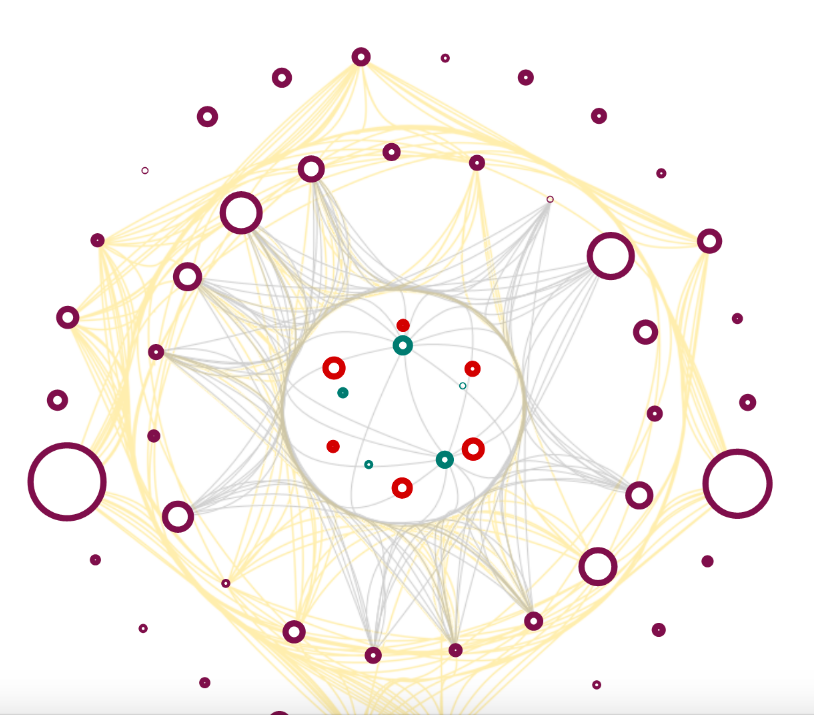
Whether we are using pen and ink or a computer program to produce visualizations, these principles are the same.
This course builds on the tools and methods learned in HUMN 100 to deepen students’ understanding of how visualization works in the humanities and to learn how design affects interpretation. The course surveys and develops students’ familiarity with a breadth of visualization tools and critical approaches to visualization and culminates in students developing their own data visualizations with their own datasets.
In this class students will learn to use:
- Gephi networking software
- ArcGis online
- Timeline JS
- Tableau
- Palladio
- Voyant
Students will have the option of learning
Required Texts/sites:
- Isabel Meirelles, Design for Information (2013)
- Visualcomplexity.com
- Manuel Lima: Visual Complexity: Mapping Patterns of Information, Princeton Architectural Press, 2011
- Recommended: Edward Tufte: Visual Explanations: Images, Quantities, Evidence, and Narrative (1997)
- Ebooks for the Meirelles and Lima books are linked above. You can either read them online (and download chapters, although there are download limits), or you can download the full ebook. You will need to create an account with and download Adobe Digital Editions if you want to download the full ebook. When you download the ebook, choose the 365 days check-out option.
Instructors:
Prof. Katherine Faull
Coleman 165
Phone: 570 577-1289
faull@bucknell.edu
Office hours MWF 1-2pm
Carrie Pirmann
Bertrand Library 107D
cmp016@bucknell.edu
Schedule an appointment with Carrie
Accommodations statement
Any student who needs an accommodation based on the impact of a disability should contact Heather Fowler, Director of the Office of Accessibility Resources at hf007@bucknell.edu, 570-577- 1188 or in room 107 Carnegie Building who will coordinate reasonable accommodations for students with documented disabilities.
